
Série Cyanotype : Fleurs du Mal


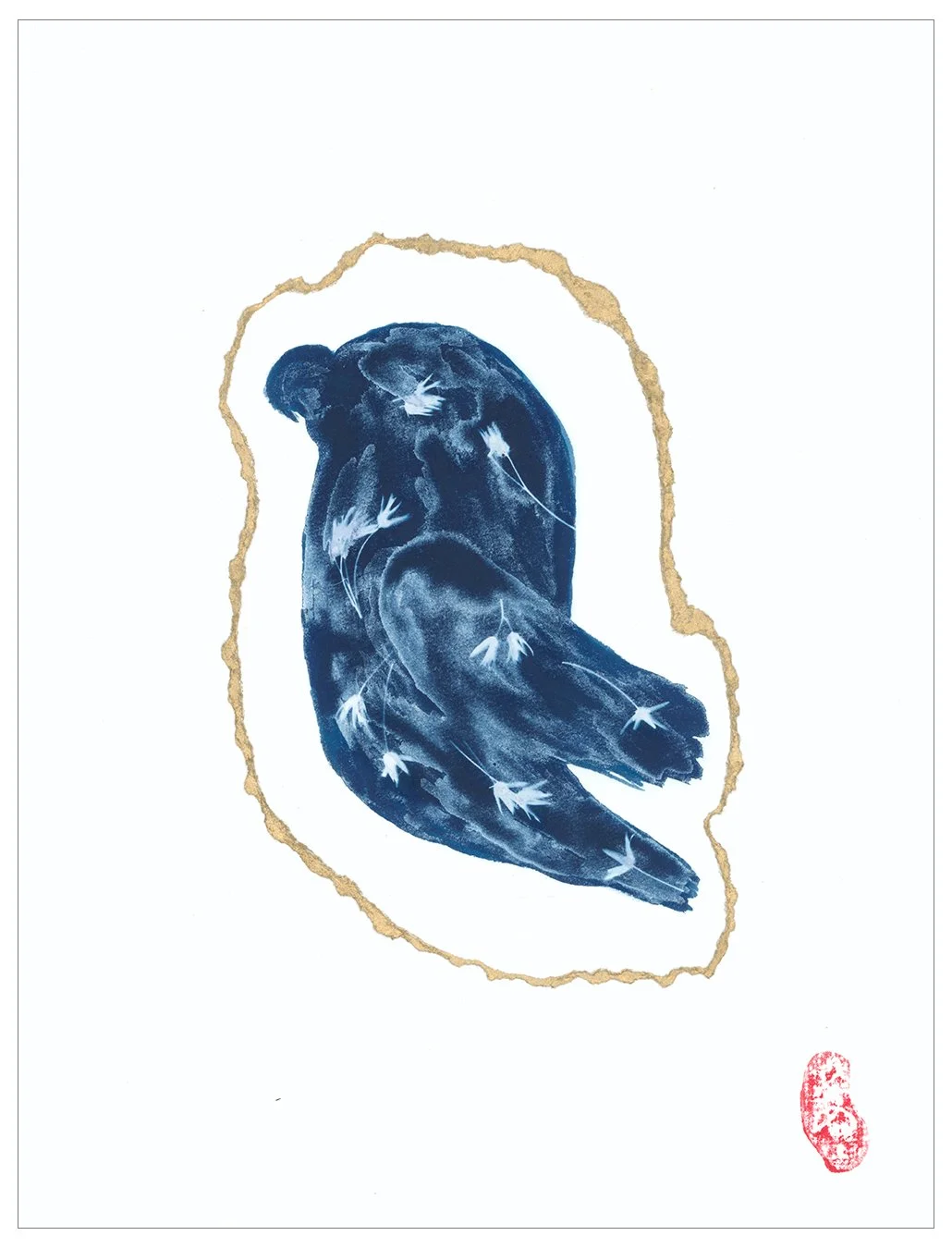

Inspirée par l’univers poétique de Charles Baudelaire et ses œuvres majeures, Les Fleurs du mal et Le Peintre de la vie moderne, cette série de cyanotypes explore les liens subtils entre la création humaine et le monde naturel, entre la beauté éphémère et l’intemporel. À l’image de la poésie baudelairienne, qui révèle la beauté jusque dans la décadence et les contradictions de l’existence, chaque œuvre cherche à saisir la poésie du vivant dans ce qu’il a de fragile, de spontané et de profondément mystérieux.
Dans Le Peintre de la vie moderne, Baudelaire évoque la double nature de la beauté : éternelle et universelle d’une part, fugitive et singulière de l’autre, intimement liée à l’esprit d’une époque. Cette réflexion nourrit ma démarche artistique. Je cherche à saisir l’instant où la matière, la lumière et le geste se rencontrent, où l’éphémère laisse une empreinte durable, transformant une expérience passagère en une présence sensible qui traverse le temps.
Nourrie par mon intérêt profond pour la culture japonaise et ses sensibilités esthétiques, ma démarche fait également écho à l’ikebana, l’art traditionnel japonais de la composition florale. Bien au-delà de l’arrangement décoratif, l’ikebana accorde une attention particulière à la ligne, à l’espace, à l’équilibre et à la présence singulière de chaque élément végétal. Cette approche contemplative, qui révèle la beauté dans la simplicité et l’impermanence, trouve une résonance naturelle dans mon travail. Comme dans l’ikebana, chaque élément est choisi et placé avec soin, non pour imiter la nature, mais pour en révéler l’énergie, le rythme et l’harmonie.
La création de chaque cyanotype se déroule en deux temps distincts. Tout d’abord, j’applique au pinceau la solution photosensible sur du papier aquarelle, dessinant des formes abstraites qui évoquent les contours, les rythmes et l’énergie des êtres vivants. Ces formes peintes constituent le premier geste de la composition, une surface ouverte à la rencontre avec le monde végétal. Puis, juste avant l’exposition au soleil, je dispose des herbes, des feuilles et des fleurs sur ces formes, composant chaque arrangement comme une œuvre éphémère. Ce dialogue entre le geste pictural initial et la disposition des végétaux, à la fois intuitive et réfléchie, confère à chaque tirage son caractère unique et inimitable.
Le soleil occupe une place essentielle dans ce processus de création. Par son action, il révèle progressivement les empreintes végétales et transforme la surface sensible en une composition aux nuances profondes de bleu. La lumière devient ainsi une force créatrice à part entière, unissant la matière végétale, le geste humain et les éléments naturels dans un processus où une part de maîtrise cède place à l’imprévisible. Chaque image conserve la mémoire de cette rencontre singulière.
Le lavage final révèle l’image dans toute sa subtilité. Les silhouettes végétales apparaissent comme les traces d’une présence désormais absente, évoquant le passage du temps, la métamorphose et la fragilité de toute forme vivante. À l’instar d’une composition d’ikebana, dont l’équilibre existe dans l’instant et demeure indissociable de la vie des végétaux, chaque cyanotype témoigne d’une beauté intrinsèquement liée à l’impermanence. Ce qui se transforme, se défait ou disparaît laisse derrière soi une empreinte qui atteste de son existence.
Cette approche traduit également mon désir d’inscrire ma pratique dans une relation attentive à l’environnement. La nature n’est pas simplement un motif représenté : elle devient une véritable collaboratrice du processus créatif. Les végétaux apportent leur forme et leur présence, tandis que la lumière solaire participe directement à la naissance de l’image. L’œuvre émerge ainsi d’une collaboration sensible entre l’artiste et le vivant.
Fleurs du Mal invite à contempler les correspondances entre l’humain et la nature, entre la beauté et la disparition, entre l’instant fugitif et sa persistance dans la mémoire. En faisant dialoguer la poésie de Baudelaire avec la sensibilité esthétique japonaise, cette série explore la tension entre l’éphémère et l’intemporel, entre la spontanéité du vivant et l’intention artistique. Chaque cyanotype devient une méditation sur la fragilité de l’existence et sur cette part d’éternité que l’art nous permet parfois d’entrevoir au cœur même de ce qui passe.
English
Inspired by the poetic universe of Charles Baudelaire and his seminal works, Les Fleurs du mal (The Flowers of Evil) and Le Peintre de la vie moderne (The Painter of Modern Life), this series of cyanotypes explores the subtle connections between human creation and the natural world, between ephemeral beauty and the timeless. In the spirit of Baudelaire’s poetry, which discovers beauty even in decay and in the contradictions of existence, each work seeks to capture the poetry of life in its most fragile, spontaneous, and deeply mysterious forms.
In The Painter of Modern Life, Baudelaire reflects on the dual nature of beauty: eternal and universal on the one hand, fleeting and singular on the other, intimately bound to the spirit of an age. This reflection resonates deeply with my artistic practice. I seek to capture the moment when matter, light, and gesture converge, when the ephemeral leaves a lasting trace, transforming a passing experience into a tangible presence that endures through time.
Nourished by my enduring interest in Japanese culture and its aesthetic sensibilities, my approach also echoes ikebana, the traditional Japanese art of flower arrangement. Far more than a decorative practice, ikebana gives profound importance to line, space, balance, and the singular presence of each botanical element. This contemplative approach, which reveals beauty through simplicity and impermanence, finds a natural resonance in my work. As in ikebana, each element is carefully chosen and placed, not to imitate nature, but to reveal its energy, rhythm, and harmony.
The creation of each cyanotype unfolds in two distinct stages. First, I brush the light-sensitive cyanotype solution onto watercolor paper, painting abstract forms that evoke the contours, rhythms, and vital energy of living beings. These painted shapes form the initial gesture of the composition, an open surface awaiting its encounter with the vegetal world. Then, just before exposing the print to sunlight, I arrange grasses, leaves, and flowers upon these forms, composing each arrangement as a fleeting work of art. This dialogue between the initial painted gesture and the placement of the botanical elements—at once intuitive and deliberate—gives every print its own singular, unrepeatable character.
The sun plays an essential role in this creative process. Through its action, it gradually reveals the botanical silhouettes, transforming the sensitized surface into a composition of deep, resonant blues. Light becomes a creative force in its own right, bringing together vegetal matter, the human gesture, and the natural elements in a process where a measure of control gives way to the unpredictable. Each image preserves the memory of this singular encounter.
The final wash reveals the image in all its subtlety. The botanical silhouettes emerge as traces of a presence that has since vanished, evoking the passage of time, transformation, and the fragility of all living forms. Like an ikebana arrangement, whose balance exists in the present moment and remains inseparable from the life of the plants themselves, each cyanotype bears witness to a beauty intrinsically bound to impermanence. That which transforms, withers, or disappears leaves behind a trace that attests to its existence.
This approach also reflects my desire to ground my practice in a thoughtful relationship with the environment. Nature is not merely a subject to be represented; it becomes an active collaborator in the creative process. The botanical elements contribute their forms and presence, while sunlight participates directly in the birth of the image. The artwork thus emerges from a sensitive collaboration between the artist and the living world.
Flowers of Evil invites us to contemplate the correspondences between humanity and nature, between beauty and disappearance, between the fleeting moment and its persistence in memory. Bringing Baudelaire’s poetry into dialogue with Japanese aesthetic sensibilities, this series explores the tension between the ephemeral and the timeless, between the spontaneity of the living world and artistic intention. Each cyanotype becomes a meditation on the fragility of existence and on that elusive trace of eternity that art sometimes allows us to glimpse at the very heart of all that passes.